
AWS VPC Networking Overview
Amazon Virtual Private Cloud (VPC) is a foundational networking service in AWS. It allows you to provision logically isolated virtual networks within AWS, where you can launch and manage AWS resources with fine-grained control over networking.
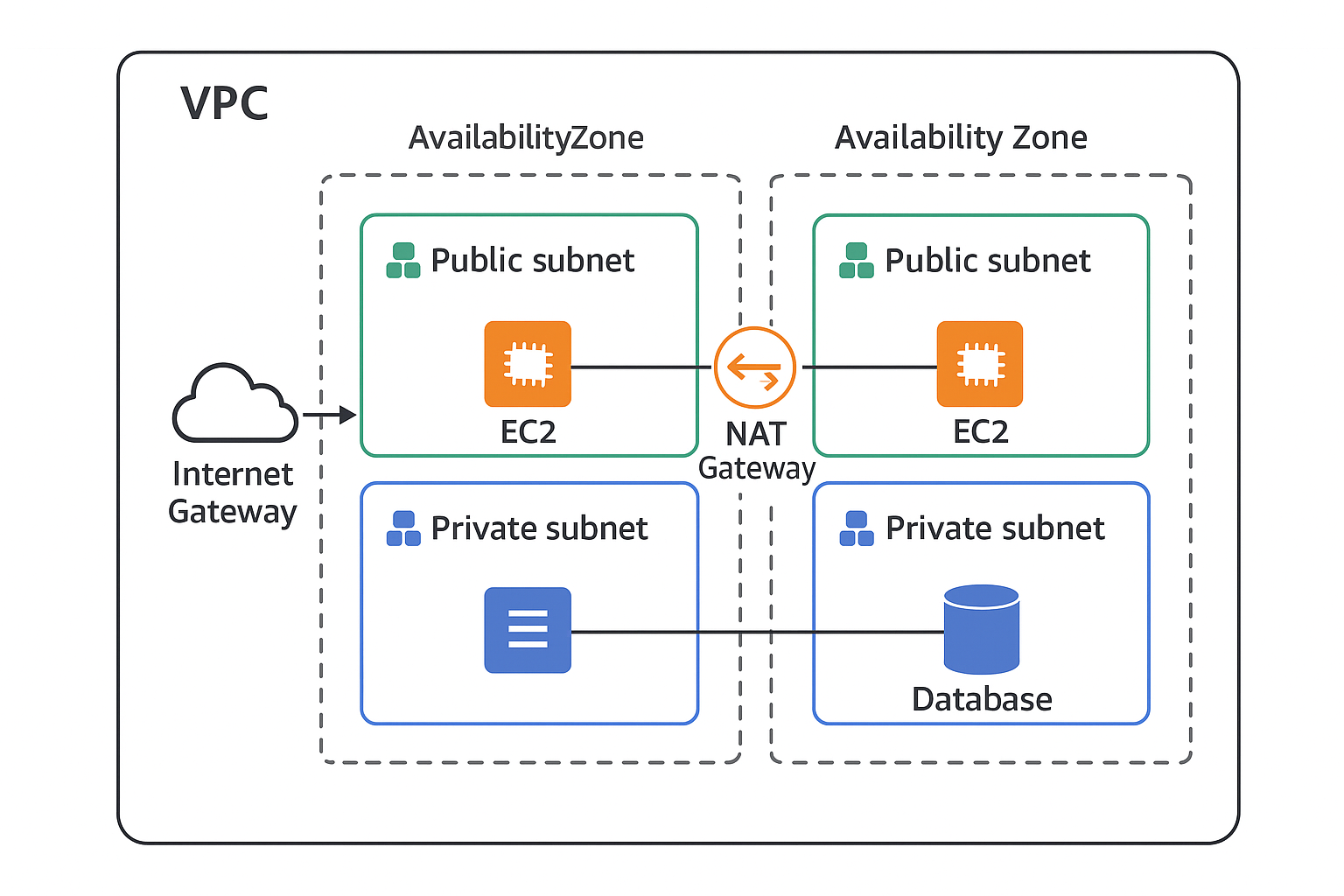
Core Concepts
- VPC: A virtual network dedicated to your AWS account.
- Subnets: Logical segments of a VPC. Each subnet is tied to a single Availability Zone (AZ).
- Public subnet: Has a route to the internet via an Internet Gateway (IGW).
- Private subnet: No direct access from the internet; often used for databases or application servers.
- CIDR Blocks: IP address ranges assigned to the VPC and subnets (e.g.,
10.0.0.0/16).
Key Networking Components
Route Table
Defines how traffic from subnets is routed (to IGW, NAT Gateway, peering connection, etc.).Internet Gateway (IGW)
Enables resources in a public subnet to communicate with the internet.NAT Gateway/Instance
Allows instances in private subnets to access the internet (for updates, downloads) without being exposed to inbound internet connections.Elastic IP
A static, public IPv4 address for instances or NAT gateways.VPC Peering
Connects two VPCs privately using AWS backbone network. No transitive peering is supported.Transit Gateway (TGW)
A central hub for connecting multiple VPCs and on-premises networks, simplifying complex topologies.VPN & Direct Connect
- VPN: Securely connects VPC with on-premises networks via IPSec tunnels.
- Direct Connect: Dedicated private connection between data center and AWS.
Security Controls
- Security Groups (SG): Stateful, instance-level firewalls controlling inbound/outbound traffic.
- Network ACLs (NACLs): Stateless, subnet-level traffic rules, useful for additional restrictions.
Typical VPC Design
- Multi-tier architecture:
- Public subnet → Load balancer, bastion hosts.
- Private subnet → Application servers.
- Isolated subnet → Databases, sensitive workloads.
- High availability: Create subnets across multiple AZs.
- Hybrid Cloud: Extend your VPC to data centers via VPN/Direct Connect.
Best Practices
- Use CIDR blocks that don’t overlap with on-premises networks.
- Segment workloads by subnets and use least-privilege SG/NACL rules.
- Enable VPC Flow Logs for visibility into traffic.
- For scalability, consider Transit Gateway over many peering links.
- Use IPv6 if you expect high growth in IP needs.