
Agile Planning Concepts
There Are three concepts for Agile planning:
- Effort vs Duration.
- Accuracy vs Precision.
- Relative vs Absolute.
1. Effort vs. Duration:
Effort:
- Effort is about the amount of work required to complete a task or project.
- It's measured in units like person-hours, person-days, or story points.
- Effort is not tied to the calendar but rather to the work itself.
- Think of it this way: if a task needs 40 hours of effort, that's 40 hours of work regardless of whether you spread it over a week, a month, or get multiple people to work on it.
Duration:
- Duration is the actual time that will pass from the start to the finish of a task or project.
- It's measured in calendar days, weeks, or months.
- Duration depends on how many people are working on the task and their availability.
- For example, if one person works full-time on a 40-hour task, the duration is 5 days. If two people work on it, the duration might be 2.5 days.
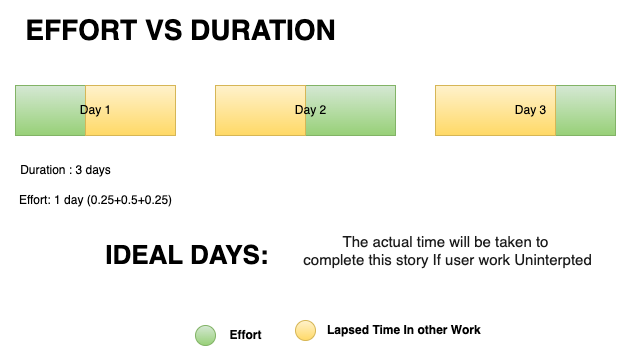
In Summary:
- Effort is about the total work needed; duration is about the total time taken.
- They are connected but not the same: a high-effort task can have a short duration if many people work on it, and a low-effort task can have a long duration if resources are limited.
2. Accuracy vs. Precision:
Accuracy:
- Accuracy is about how close your estimate or measurement is to the actual value or outcome.
- If you estimate a task will take 10 hours and it actually takes 10 hours, your estimate is accurate.
Precision:
- Precision is about the consistency and detail of your estimates or measurements.
- If you repeatedly estimate tasks with very similar outcomes, your estimates are precise.
- For example, estimating a task will take exactly 10.1234 hours is precise, but it may not be accurate if the actual time varies widely.
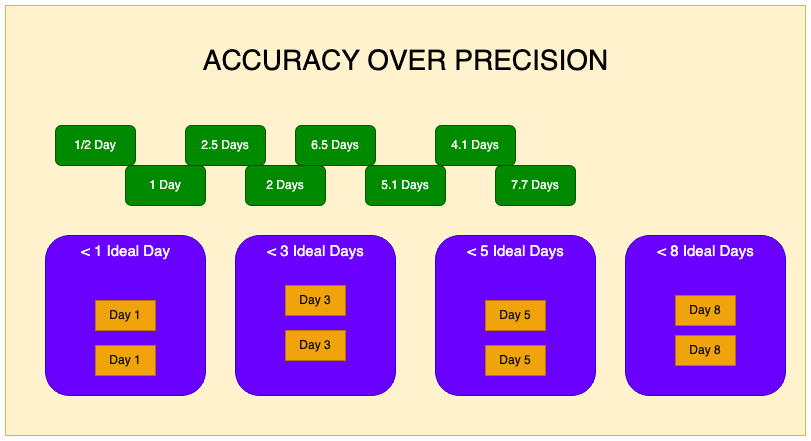
In Summary:
- Accuracy means getting close to the actual value; precision means being consistently detailed.
- Ideally, you want both accurate and precise estimates, but in practice, it's often more important to be accurate in Agile planning.
3. Relative vs. Absolute Estimation:
Relative Estimation:
- This involves comparing the size or complexity of tasks against each other rather than assigning fixed time units.
- Common in Agile, using techniques like story points or t-shirt sizes (e.g., small, medium, large).
- For instance, if Task A is twice as complex as Task B, and Task B is 2 story points, then Task A is 4 story points.
Absolute Estimation:
- This involves estimating the effort or duration in fixed time units, such as hours or days.
- More traditional and straightforward but can be challenging in the face of uncertainties.
- For example, estimating that Task A will take exactly 8 hours.
In Summary:
- Relative estimation focuses on comparing tasks to each other, making it flexible and adaptive to changes.
- Absolute estimation provides concrete timelines but can be hard to get right in complex projects.
- Agile prefers relative estimation for its adaptability and ease of comparison.