
Agile Planning
Agile planning is a methodology used to deliver projects more efficiently and effectively by breaking them down into manageable increments. It allows teams to adapt to changing requirements and deliver value iteratively. Here are the key components and steps involved in Agile planning:
Key Components of Agile Planning
- Product Backlog: A prioritized list of features, enhancements, bug fixes, and other work items for the product.
- Sprint Planning: A meeting where the team selects items from the product backlog to work on during the upcoming sprint.
- Sprints: Short, time-boxed periods (usually 1-4 weeks) during which the team works on the selected items.
- Daily Standups: Short, daily meetings where team members discuss their progress, plans for the day, and any impediments.
- Sprint Review: A meeting at the end of the sprint to demonstrate the completed work to stakeholders.
- Sprint Retrospective: A meeting after the sprint review to discuss what went well, what didn't, and how to improve.
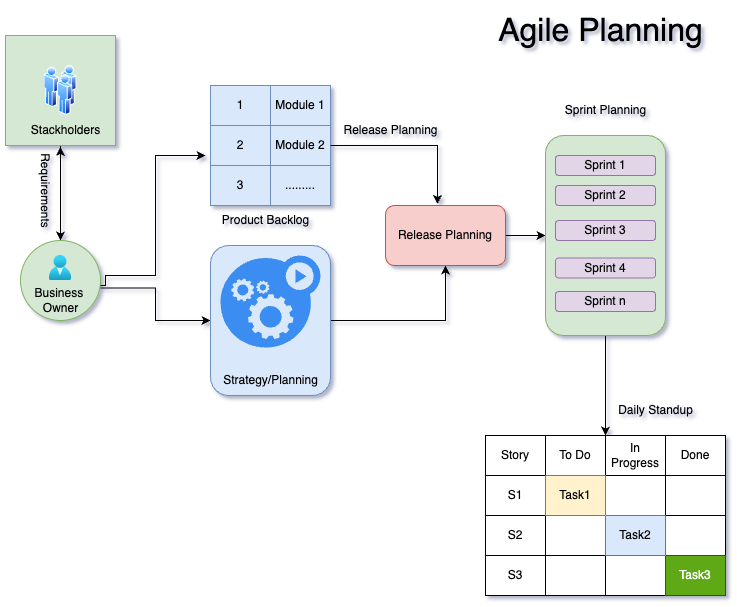
Agile Planning Image
Steps in Agile Planning
- Define the Vision and Goals:
- Understand the product vision and business goals.
- Identify stakeholders and their needs.
- Create and Prioritize the Product Backlog:
- Work with stakeholders to gather requirements and create user stories.
- Prioritize the user stories based on business value, risk, and dependencies.
- Sprint Planning:
- Review the product backlog and select items for the upcoming sprint.
- Define the sprint goal and break down user stories into tasks.
- Estimate the effort required for each task (using story points, hours, etc.).
- Execute the Sprint:
- Team members work on the tasks, attending daily standups to coordinate and resolve issues.
- Use a task board (e.g., Kanban) to track progress.
- Sprint Review and Retrospective:
- Demonstrate the completed work to stakeholders during the sprint review.
- Gather feedback and update the product backlog as needed.
- Conduct a sprint retrospective to discuss improvements for the next sprint.
- Iterate and Improve:
- Apply insights from the retrospective to improve processes.
- Repeat the cycle, continuously delivering increments of the product and refining the approach.